The Poetry of Imperfection
In a converted Victorian mill in Hebden Bridge, Sarah Chen holds up a wool jumper that's seen better decades. The sleeves are moth-eaten, the collar frayed beyond rescue. Most would see rubbish. Sarah sees potential poetry.
 Photo: Hebden Bridge, via m.media-amazon.com
"Every hole tells a story," she explains, threading her needle with copper-coloured silk. "Why hide that narrative when you can illuminate it?"
Sarah is part of Britain's growing visible mending movement—a philosophy borrowed from Japanese kintsugi that treats repair as an art form rather than a shameful necessity. Across the UK, from Glasgow community centres to Brighton beach huts, makers are discovering that the most luxurious thing you can own isn't something perfect, but something perfectly imperfect.
Beyond Fast Fashion's False Promise
The visible mending revolution couldn't have arrived at a better moment. As Britain grapples with textile waste mountains and the environmental cost of our throwaway culture, these repair artists offer something radical: the idea that longevity is the ultimate luxury.
"Fast fashion sold us the lie that newness equals value," says Marcus Rodriguez, who runs weekend darning workshops from his Shoreditch studio. "But there's something deeply magical about wearing a garment that carries your history. These repairs become like tattoos—marks of time lived fully."
Marcus's workshops are booked months in advance, filled with fashion-conscious Londoners who arrive clutching beloved pieces they refuse to abandon. A vintage Westwood blazer with elbow holes. Doc Martens with separated soles. A grandmother's hand-knitted cardigan unravelling at the seams.
"We're not just fixing clothes," he continues, demonstrating a decorative patch technique that transforms a tear into a constellation of gold stitching. "We're rewriting the relationship between perfection and beauty."
The Alchemists of Thread
In rural Dorset, textile artist Freya Morrison has built her entire practice around what she calls "scar worship." Her Instagram account showcases garments transformed through visible mending—denim jackets mapped with embroidered lightning bolts, woollen coats blooming with mushroom-shaped patches, silk scarves webbed with metallic thread repairs.
"There's something profoundly rebellious about celebrating damage," Freya explains from her cottage studio, surrounded by baskets of reclaimed fabric and rainbow spools of thread. "We live in a culture obsessed with hiding our wear and tear. But what if we wore our repairs like badges of honour instead?"
Her commissions come from across Britain—fashion editors wanting to rescue vintage pieces, students learning to see beauty in breakdown, older customers rediscovering garments they thought were beyond saving.
The techniques vary wildly. Some practitioners favour bold, contrasting patches that announce themselves proudly. Others work in subtle tonal variations, creating repairs that whisper rather than shout. There's needle felting, where wool fibres are stabbed into holes to create cloud-like patches. Sashiko-inspired running stitches that turn tears into geometric meditation. Embroidered gardens that bloom from worn spots like flowers through pavement cracks.
Building Your Repair Ritual
The beauty of visible mending lies in its accessibility. Unlike haute couture or designer collaborations, this movement belongs to anyone willing to pick up a needle. But where do you begin?
"Start with something you love but can't wear," suggests Emma Walsh, who teaches repair workshops across the North West. "That favourite jumper with the hole. Those jeans that split. Don't think about perfection—think about personality."
Emma recommends building a basic repair kit: embroidery hoops, a selection of needles, threads in colours that speak to you, fabric scraps saved from old projects. "The tools matter less than the intention," she insists. "This is about slowing down, about mindfulness disguised as mending."
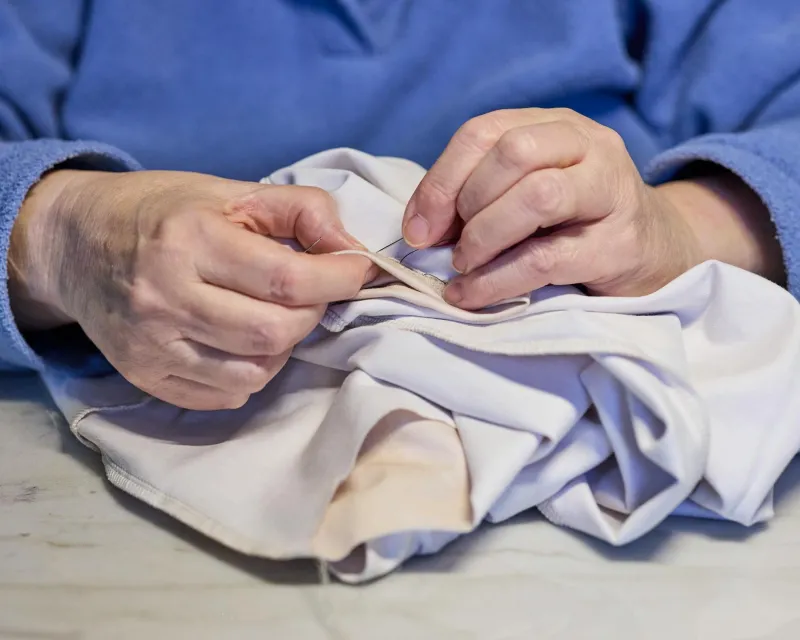
The process itself becomes meditative. There's something deeply satisfying about the repetitive motion of stitching, the gradual transformation of damage into decoration. Time slows. The world shrinks to the space between needle and fabric.
The Future Is Perfectly Imperfect
As Britain's visible mending community grows, it's attracting attention from unexpected quarters. Independent fashion brands are commissioning repair artists to "damage" new pieces, creating pre-mended garments that carry artificial histories. Luxury retailers are offering in-house mending services, recognising that their customers increasingly value longevity over newness.
"We're witnessing a fundamental shift in how we define luxury," observes fashion theorist Dr. Patricia Kingsley from Central Saint Martins. "The ultimate status symbol isn't having something no one else can afford—it's having something that carries irreplaceable personal history."
 Photo: Central Saint Martins, via c8.alamy.com
This isn't just about environmental consciousness, though that's certainly part of it. It's about reclaiming agency in our relationship with clothing. In a world of algorithmic recommendations and mass-produced sameness, visible mending offers something genuinely personal.
Every repair tells a story only you can tell. That patch covers the tear from climbing over a festival fence. Those decorative stitches mark where your cat's claws caught. The darned elbow remembers countless library afternoons.
Wearing Your Story
The visible mending movement represents something profound: the understanding that perfection is overrated, that beauty lies not in flawlessness but in the courage to wear your history openly. In a culture that profits from our insecurities, there's something revolutionary about celebrating our scars.
As Sarah Chen in Hebden Bridge finishes her moth-eaten jumper—now transformed with delicate embroidered moths that seem to dance across the wool—she holds it up to catch the afternoon light streaming through her studio windows.
"Perfect things are forgettable," she smiles. "But something beautifully broken? That stays with you forever."
In the end, that's what visible mending offers: the chance to wear not just clothing, but story. To carry our histories not as shame but as decoration. To understand that the most beautiful things are often the most broken ones—and that sometimes, breaking is just the beginning of becoming truly beautiful.