The Quiet Insurrection Happening in Britain's Sewing Rooms
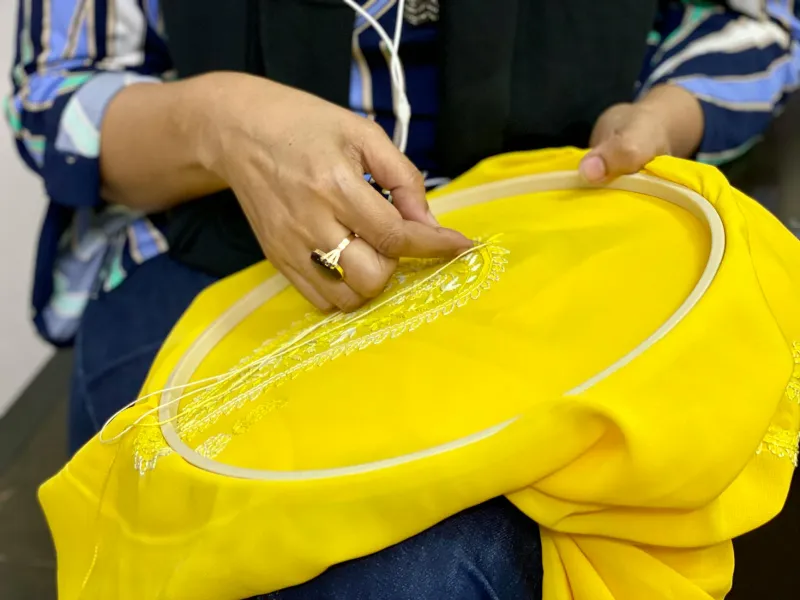
While the fashion world obsesses over the next viral trend, something extraordinary is happening in converted barns across Yorkshire, tucked-away studios in the Scottish Borders, and cramped London flats where the hum of sewing machines mingles with Radio 4. Britain's most radical fashion statement isn't being born on catwalks—it's emerging one careful stitch at a time, as a new generation of designers resurrects embroidery traditions that were nearly lost to history.
This isn't your grandmother's needlepoint. This is fashion rebellion, threaded with intention and stitched with purpose.
When Ancient Crafts Become Modern Weapons
There's something profoundly subversive about choosing a hand-embroidered jacket over a mass-produced alternative. In an era where a garment can travel from concept to high street in mere weeks, the decision to wear something that took months to create feels like a quiet act of resistance. Each French knot becomes a middle finger to fast fashion; every chain stitch, a declaration of independence from the tyranny of trend cycles.
Take Northumbrian whitework—a delicate embroidery technique that once adorned the finest household linens across the North East. By the 1980s, fewer than a dozen people in Britain could execute its intricate pulled-thread patterns. Today, designers like Sarah Chen are incorporating these ghostly, geometric motifs into contemporary blazers and evening wear, transforming forgotten domestic craft into high-fashion armour.
"When someone asks about my jacket, I'm not just talking about fashion," explains Chen from her Newcastle studio, surrounded by samplers dating back to the 1800s. "I'm telling them about the women who sat by candlelight perfecting these stitches, about skills that nearly vanished because we decided they weren't valuable enough to preserve."
The Geography of Lost Stitches
Britain's embroidery heritage reads like a secret map of regional identity. Dorset's distinctive button-making tradition—where threads were wound over metal rings to create intricate, sculptural fasteners—was nearly extinct until designer Marcus Webb discovered a cache of Victorian samples in a Sherborne antique shop. Now his contemporary coats feature these architectural buttons as statement pieces, each one requiring three hours of precise handwork.
In the Welsh valleys, the ancient art of crewelwork—bold, naturalistic embroidery worked in worsted wool—is experiencing an unlikely renaissance. Studio Cymru, a collective of six designers based in Llanfairpwll, creates modern interpretations of traditional Welsh motifs: stylised leeks morph into abstract florals on silk scarves; the red dragon becomes a serpentine thread painting across the back of a bomber jacket.
"We're not interested in heritage as museum piece," says collective member Rhiannon Thomas. "These techniques survived because they were useful, beautiful, and meaningful. Our job is to make them useful, beautiful, and meaningful again."
The Economics of Slow Beauty
Choosing embroidered fashion is an economic statement as much as an aesthetic one. In a marketplace where a high street dress costs less than a decent bottle of wine, paying £300 for a hand-stitched blouse feels radical. But this is precisely the point. These pieces aren't competing with fast fashion—they're offering an entirely different value system.
Consider the mathematics of a Blackwork sampler sleeve. Traditional Blackwork, with its geometric patterns worked entirely in black silk on white linen, requires approximately 40 hours to complete a single garment. At living wage rates, that's £400 in labour alone—before accounting for design, materials, or overhead. The resulting piece isn't just clothing; it's wearable sculpture, historical preservation, and economic activism rolled into one.
The New Guardians of Ancient Knowledge
Across Britain, a network of unlikely preservationists is emerging. There's Jamie Morrison, a former investment banker who learned Ayrshire whitework from the last practitioner in Irvine before establishing a teaching studio in Glasgow. His students—ranging from fashion graduates to retired teachers—are creating contemporary pieces that honour the technique's mathematical precision while pushing its creative boundaries.
In Cornwall, the Goldwork Revival Project is training a new generation in the opulent embroidery techniques once reserved for ecclesiastical vestments and military uniforms. Their contemporary pieces—leather jackets adorned with gold thread dragons, silk scarves scattered with metallic butterflies—prove that luxury needlework can be both historically grounded and utterly modern.
Why This Matters Now
The embroidery revival isn't happening in a vacuum. As consumers increasingly question the environmental and social costs of their wardrobes, these ancient techniques offer a compelling alternative narrative. Each piece represents not just individual artistry, but collective memory—skills passed down through generations, regional identities preserved in thread, and economic models that prioritise craft over volume.
"When you wear hand embroidery, you're making a statement about time," observes textile historian Dr. Patricia Flemming. "You're saying that some things are worth waiting for, worth paying for, worth preserving. In our instant-gratification culture, that's genuinely radical."
Stitching the Future
The most exciting aspect of Britain's embroidery revival isn't its reverence for the past—it's its vision for the future. These aren't costume pieces or heritage replicas, but contemporary garments that happen to carry centuries of cultural DNA in their stitches.
As we stand at the crossroads between disposable fashion and sustainable style, perhaps the path forward lies not in revolutionary new technologies, but in revolutionary old ones. In choosing the forgotten stitch, we're not just preserving the past—we're threading together a more thoughtful future, one careful stitch at a time.
After all, in a world of mass production, the most radical act might just be taking the time to create something beautiful by hand.